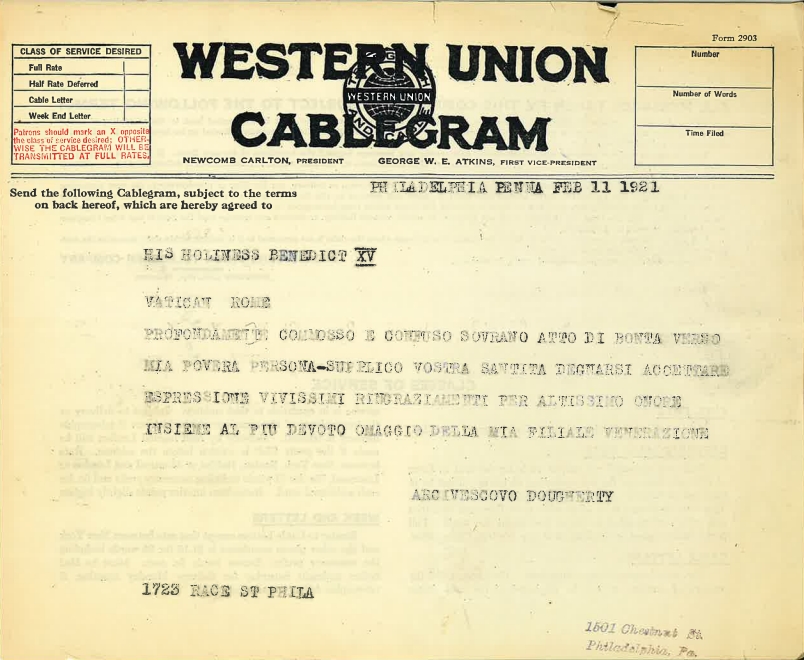
Western Union cablegram from Archbishop-elect Dougherty to Pope Benedict XV
While presiding over Canon Law examinations at Saint Charles Borromeo Seminary on February 11, 1921, Archbishop Dougherty received word that Pope Benedict XV had elevated him to the rank of Cardinal. This would make Dougherty the first Cardinal for the Archdiocese of Philadelphia, the fifth American resident Cardinal, and the fourth American-born to be elected to the College of Cardinals. In a response to His Holiness the same day (shown on the left), Archbishop Dougherty wrote: "Profoundly moved and deeply touched, I offer you my heartfelt thanks for the gracious blessing bestowed on me. I pray for your health and for the continued flourishing of the Holy See. I remain, with the utmost devotion.” Once the news was announced, a “grand and chorus of joy and gratification swelled up in the hearts of the faithful.” The following week on February 19th, Cardinal-elect Dougherty and members of the clergy made their way by train to Hoboken, New Jersey, where they boarded the Nieuw Amsterdam for Europe. According to a report by the Catholic News Service:
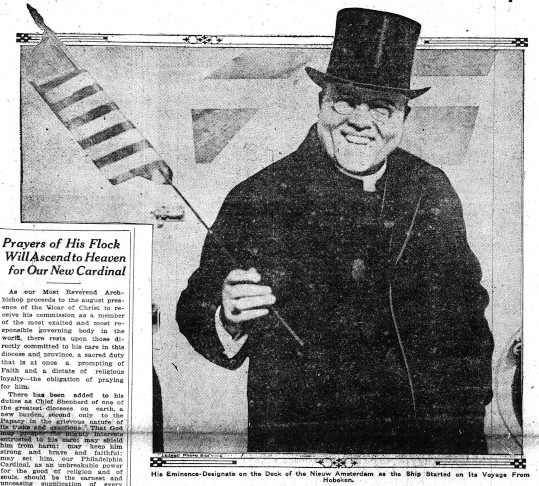
Archbishop- elect Dougherty on board the Nieuw Amsterdam
Four hundred clergymen and laymen of Philadelphia accompanied Archbishop Dougherty to New York… Seven special cars were required to bring the big delegation to Hoboken… Thousands of men and women who awaited his arrival at the pier knelt as he passed through their midst to the vessel and when he reached the decks hundreds of others greeted him and filed up to congratulate him and kiss the episcopal ring… When the visitors had gone ashore, Archbishop Dougherty stood on the starboard side of the liner amidships… Just before the liner pulled cut, at a given signal, came the parting salute of flowers. The red carnations worn by the Philadelphia party, roses, violets and orchids were thrown in the air and showered down on the smiling prelate as the Nieuw Amsterdam moved out into the river.
The ship reached Europe on the 29th and docked at Boulogne-sur-Mer in France, where the Cardinal-elect and his entourage were greeted by a delegation of the Knights of Columbus. They were then escorted to Paris, and Dougherty and the other Philadelphia clergy boarded a train to Rome. While in Rome, Archbishop Dougherty stayed at the North American Pontifical College.
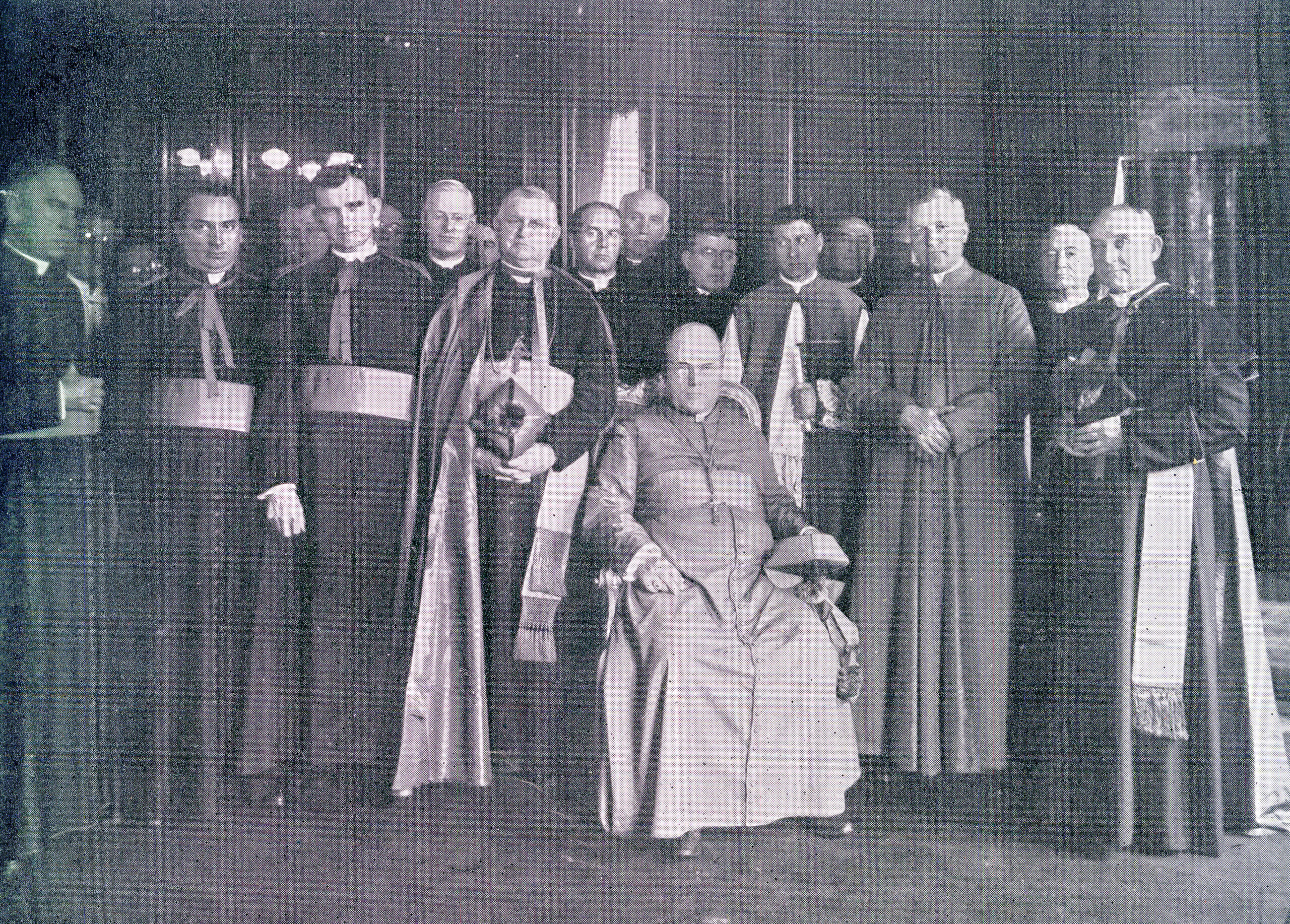
In this picture the Cardinal-elect sits in the parlor of the American College, Rome, awaiting the visit of the Vatican Emissary to give formal notice of his elevation to the Cardinalate. Figures in the front row from right to left are : Msgr. Patrick J. Supple, a classmate from Boston; Msgrs. Grosso and Respighi, Papal Masters of Ceremonies; Msgr. McCullough, Philadelphia; Bishop Allen, Mobile, Ala.; Msgrs. Fitzpatrick and Crane, Philadelphia; Msgr. O’Hern, rector, and Msgr. Mahoney, spiritual director of North American College.
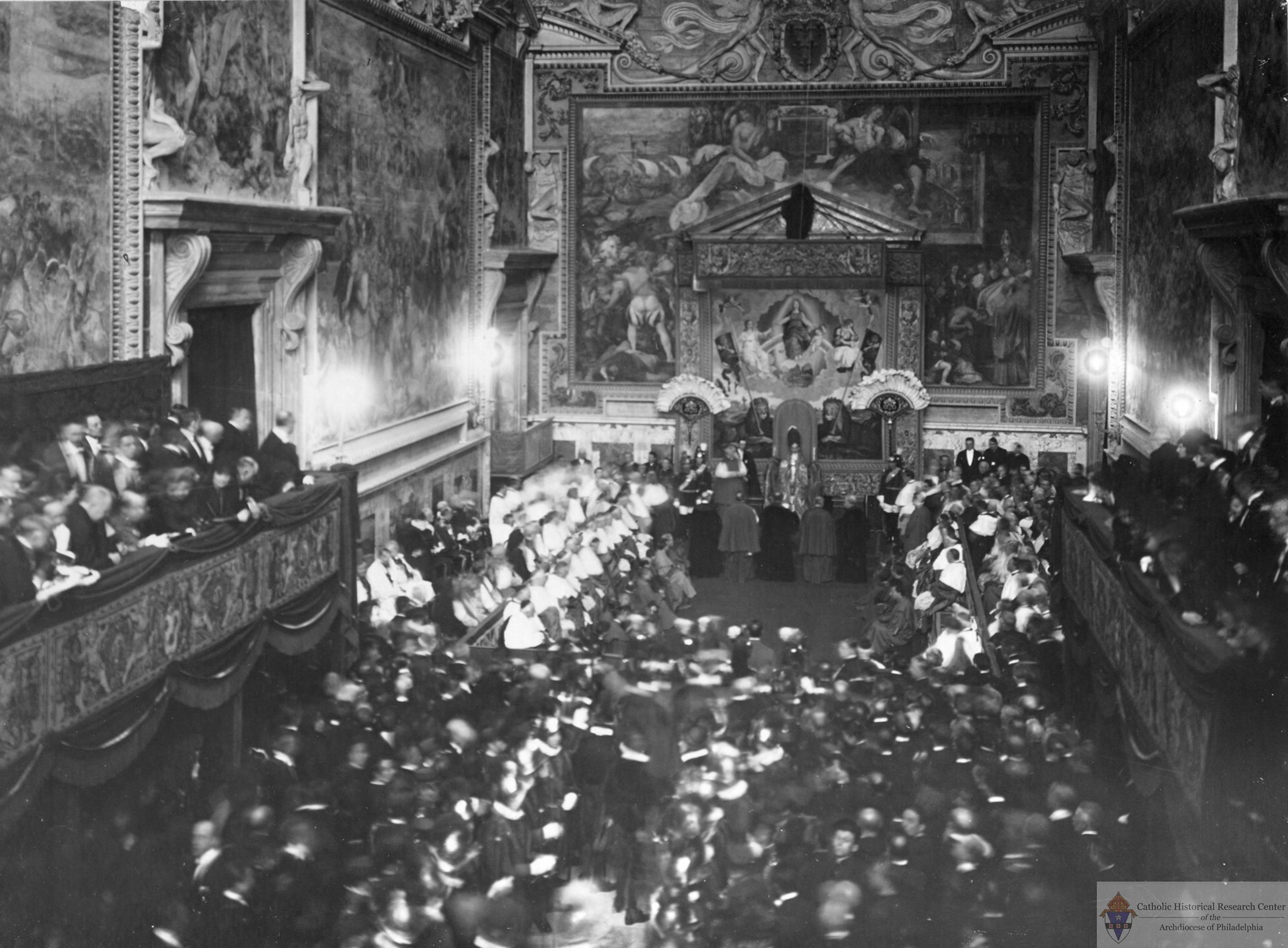
Scene during enrollment of new Cardinals in the Sala Regia
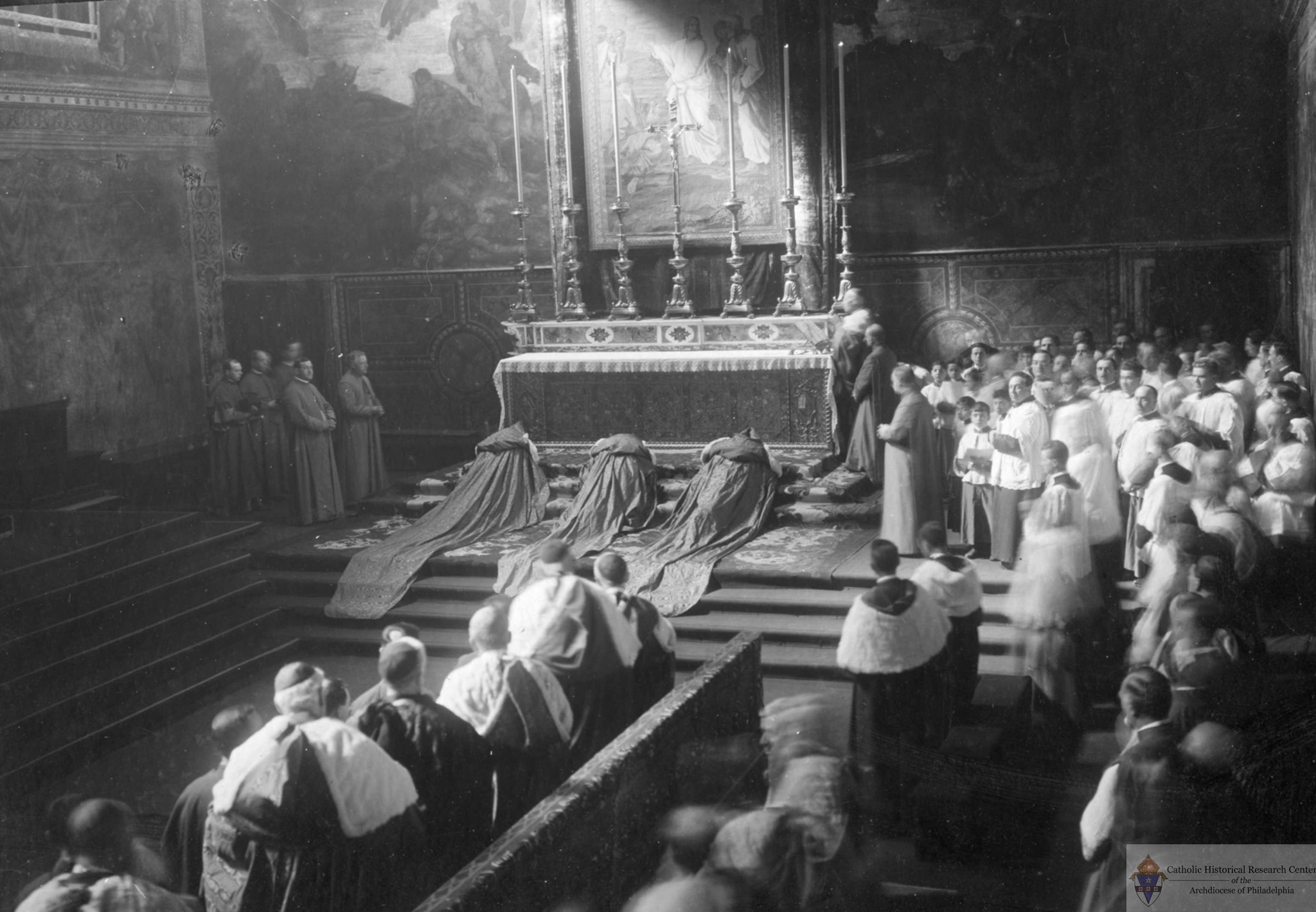
The new Cardinals prostrate themselves before the altar in the Sistine Chapel. Cardinal Dougherty is in the middle between Cardinals von Faulhaber and Schulte.
On March 7th, Archbishop Dougherty was made a Cardinal by Pope Benedict XV and given the symbols of the Cardinal rank: a scarlet zucchetto, a scarlet biretta (four-cornered hat), and a ring. This occurred alongside the elevations of Archbishops Michael von Faulhaber of Munich and Charles Joseph Schulte of Cologne. Immediately after the public consistory was a secret consistory held in the Sala del Consistoro. Unlike the public consistory that is open to family and those traveling with the Cardinal-elects, the secret consistory is only attended by the College of Cardinals. The March 12 issue of the Catholic Standard and Times talked about this meeting:
At this private ceremony one most ancient and solemn rite of the Church was performed, namely, “the closing and the opening of the mouths,” giving right to the new Cardinals to speak in the Council' of the Church. Before the assembled College, the Pope placed his hand in turn on the lips of each of the new Cardinals, saying, “I close your mouth so that you shall not be heard.” Then taking his hand from the pealed lips of each recently chosen Cardinal, the Holy Father said: “I open your mouth that you may be heard in the name of the Father, and of the Son, and of the Holy Ghost”
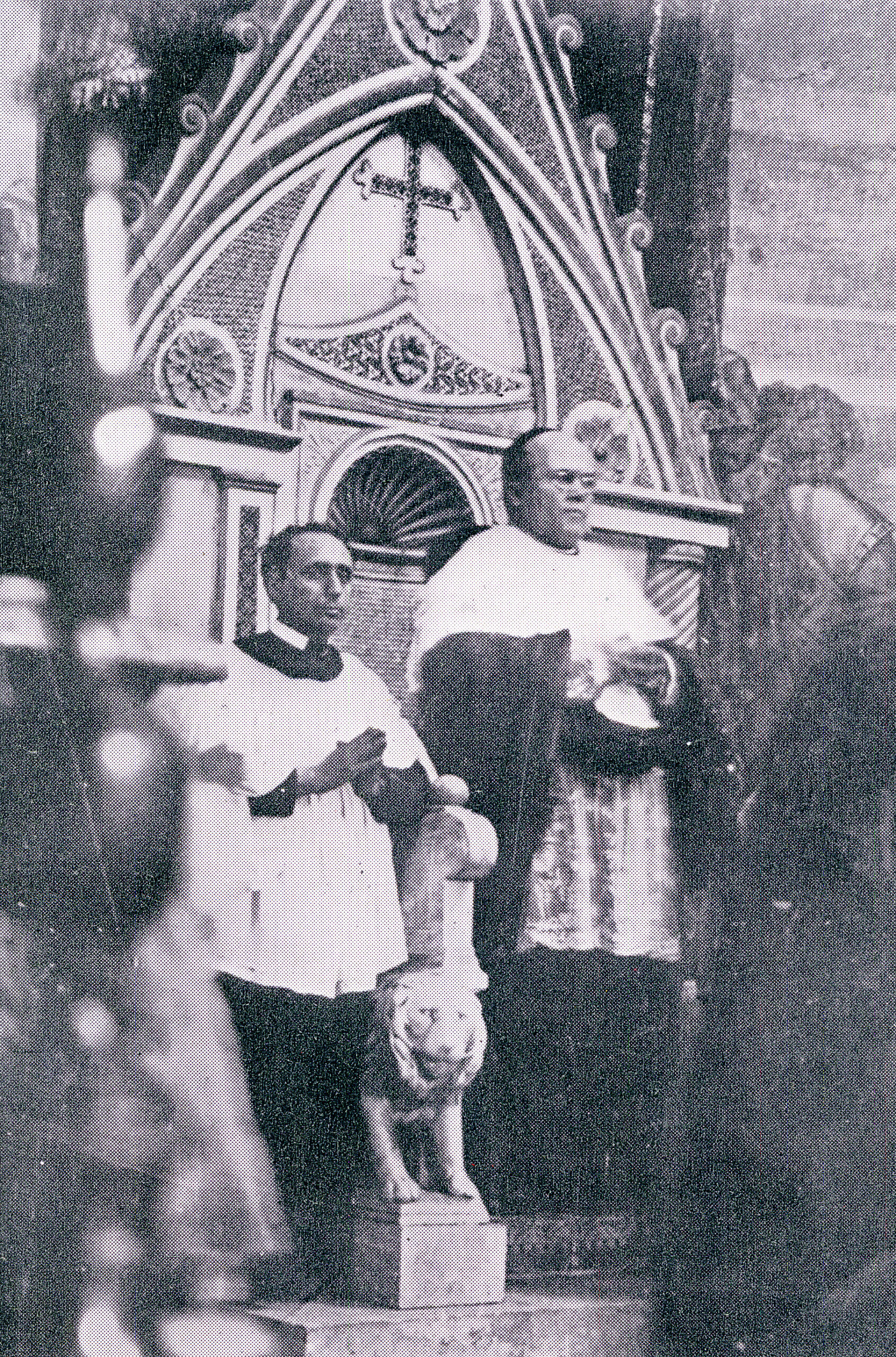
Cardinal Dougherty at the throne of his Titular Church of Saints Nereus and Achilleus, Rome, Palm Sunday, March 20, 1921
Every newly made Cardinal is given a titular church. These are Catholic churches in the city, within the jurisdiction of the Diocese of Rome, that serve as honorary designations symbolizing the relationship of cardinals to the pope, the bishop of Rome. On the Sunday afternoon following the consistory, Palm Sunday, Cardinal Dougherty took possession of his titular church of Saints Nereus and Achilleus, name for two martyrs under the Emperor Diocletian. After ascending the throne, the new Cardinal gave an address of welcome and thanks:
To our Holy Father Benedict XV, I am beholden for having assigned to me as My titular church this ancient and historic temple dedicated to Saints Nereus and Achillues and entrusted to the care of Saint Philip Neri’s children (the Oratorians). The Vicar of Christ has brought me into closer contact with the gentle Apostle of Rome and his congregation, dear to the English-speaking world for many reasons, but especially for having numbered in its ranks that profound and original thinker, that master of stately style, the great-souled Cardinal Newman.
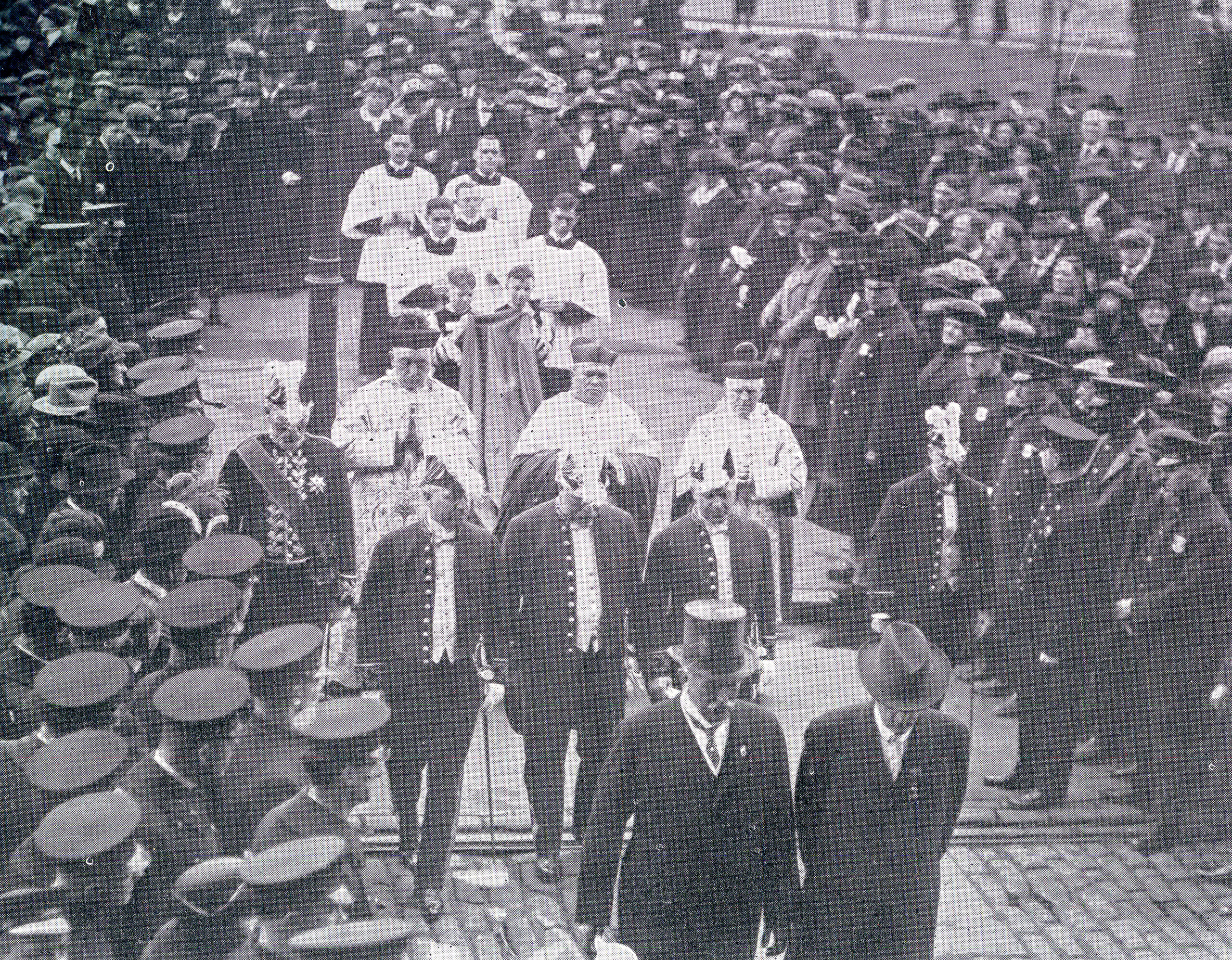
Cardinal Dougherty entering the Cathedral of Saints Peter and Paul from Logan Square
A month after arriving in Europe, Cardinal Dougherty began his journey back to the United States, boarding the Olympic in France. New York City was the scene of large crowds and warm well wishers as His Eminence preceded up New York Harbor. When the Cardinal and his party were joined by the mayor of New York in Manhattan, traffic halted and the people there on a typical business day stopped to join the public welcome. Two trains were needed to carry the Cardinal and his entourage back to Philadelphia, stopping in Trenton and the Frankford neighborhood to pick up more dignitaries. The Catholic Standard and Times reported the scene as the Cardinal arrived back in Philadelphia:
Broad Street from Logan to extreme South Philadelphia was an avenue of light and color and vibrant with an enthusiasm, the like of which the city had never seen before. Tens of thousands of American flags were held aloft in tireless hands or flung from churches, schools, business houses and private homes. Church bells tolled in the steeples of Catholic and non-Catholic churches alike. Hymns of thanksgiving intermingled with deafening cheers, while hundreds of bands poured forth stirring strains of the "Te Deum" and other hymns. Every parish in the city and surrounding suburbs participated fa the demonstration, many of them with thousands in line, marching from their respective churches to the positions assigned along Broad Street.
On Tuesday, April 19th, Cardinal Dougherty presided over a Mass of Thanksgiving at the Cathedral of Saints Peter and Paul. In an address at the luncheon following the Mass: Cardinal Dougherty ended with these words:
And now, if you permit me, I shall make a disclosure. When in the Philippines and Buffalo, although treated in both places with a kindness beyond my deserts, I always felt a sorrow in my heart that I had ceased to belong to the clergy of Philadelphia. This feeling was intensified, whenever I visited my native diocese, as I did in 1912, and several times after my appointment to Buffalo. I was a stranger in my home; although it could by no means be said that I came unto my own and my own received me not. On the contrary, nothing could exceed your kindness and goodness to me. But the separation was painful, because I would rather be a priest of the diocese of Philadelphia than of any other diocese in the world. I hope that my promotion will not cause another separation; that is, that there will never be a chasm between us because of the color of my garb. On the contrary, I look for a continuance of those familiar and affectionate relations which I have ever had with priests among whom I was born, reared and worked; who are now not merely co-workers, but my friends and companions.